
Use AI without giving up control of your data.
Most AI tools send your company data to third-party servers. We build AI that stays with you: GDPR-compliant, on EU servers, without data leaks.
The problem with standard AI
Anyone who puts documents, customer data or internal knowledge into public AI services gives up control. Standard subscriptions without a data processing agreement often do not settle where the data is stored, who can see it and whether it flows into training. Even with an agreement, a third party processes the data on its servers. For many industries that is hard to justify legally.
Data drain
Your process data runs through third-party hyperscalers. There, data protection becomes an add-on after the fact, not an architecture principle.
Loss of control
Where the data is stored, who sees it and whether it is used for training is no longer your decision. Once it is out, you cannot get it back.
Compliance risk
Starting today without a plan means expensive retrofitting later. The GDPR and the EU AI Act require documentation, transparency and control, which are hard to build in after the fact.
Data ownership is not a feature
It is an architecture principle. What sounds like a given with us is the difference from AI that was only secured after the fact:
No leaks of business data
Prompt and training data never leave your jurisdiction, at any point.
Full control over the model
You decide on version and configuration. No silent update, no black box, no surprises in operation.
EU locations as the foundation
Data processing under European law: the GDPR as the foundation of the architecture, not an add-on after the fact.
Scaling to your budget
From a lean start to your own GPU machine: the infrastructure grows with your needs.
Integration, not an island
Built into your existing IT, identity and access structure; the AI stays part of your landscape.
The difference at a glance
Sovereign AI is defined by running on your own infrastructure, strict GDPR compliance, and full control over enterprise data. Unlike standardized US cloud services, internal documents, contracts, and core know-how never leave your company network.
| Criterion | Standard AI | Sovereign AI |
|---|---|---|
| AI operation | Public US APIs | Your own servers or dedicated EU servers, in-house on request |
| Data protection | Opt-out after the fact | Data protection as an architecture principle |
| Way of working | Untested: “it will probably be fine” | Tested, with fixed rules and fallbacks |
| Knowledge | One-off prompting | Your own structured knowledge base |
| Control | Opaque black box | Approvable, auditable, human-in-the-loop |
| Dependency | Vendor lock-in | Software and infrastructure belong to you |
| Getting started | Immediate, no technology of your own | Setup needed, independent afterwards |
| Costs over time | Usage-based, rising with volume | Predictable, grows with computing power instead of per request |
Full AI benefit, full control
You get the productivity of modern AI (automation, knowledge retrieval, intelligent processes) without the price standard tools charge: your data. Secure, compliant, and without sensitive information leaving your company.
And because modern models no longer just answer but can act, you get systems that read, check, book and report: agents instead of chat. Where it matters, a person still decides: critical steps go through an approval. Every transaction is logged and stays traceable.
We test what we sell
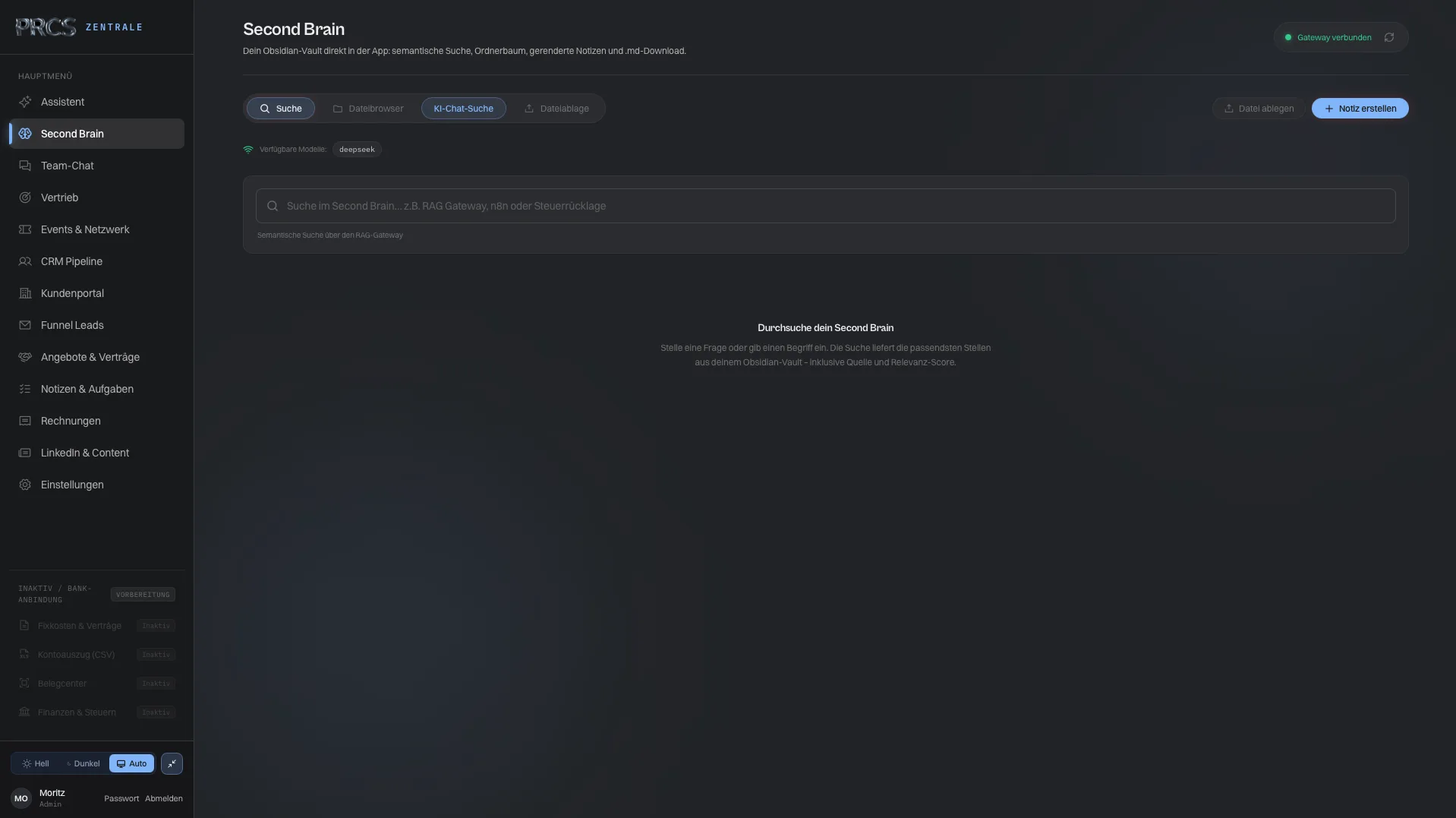
Our own knowledge base, our assistants and our content pipeline run on exactly the infrastructure we build for you, in daily operation, with the same rules for data ownership, access and approval. Anyone who sells systems they do not run themselves is selling a claim. We run them.
Our own knowledge base
Our Second Brain is a private knowledge base covering all projects, clients and decisions. You get the same design from us.
Our own AI assistants
Assistants that work on this knowledge and take on tasks: research, preparing quotes, analysis.
Our own content pipeline
From rough note to finished expert article: automated, with human approval before publication.
Data protection is not an add-on
For us, data protection is not an afterthought but a design criterion. We build so that your systems can be operated in line with data protection law and the requirements of the EU AI Act remain achievable: not so that it fits after the fact, but because it was designed that way from the start.
GDPR-compliant
Processing under European law, with data processing agreements and documented data storage.
EU AI Act in view
Transparency, documentation and human oversight are planned in from the start instead of being retrofitted later.
Professional confidentiality
For law firms, tax advisors and medical practices: systems that respect professional secrecy under § 203 StGB (German Criminal Code).
Deletion and retention
Clear rules on which data stays for how long and what is returned or deleted at the end of a project.
Our principles
Data minimization, encryption, clear access control and operation under your control.
Data minimization
Only the data the process really needs.
Encryption
In transit and at rest.
Access control
Roles and permissions, integrated into your existing structure.
Operation under your control
We configure, you own.
For us this includes a point that is rarely said out loud: no vendor lock-in. Software, workflows and intellectual property belong to you, not to us.
What people ask first
Am I not allowed to use public AI at all?
You are. For general questions with no company context there is little against it. It becomes critical as soon as customer data, contracts, HR information or internal knowledge are entered. This dividing line in the content is the real decision point.
Which questions should I ask an AI provider first?
Three: Where does the model run? Who can see the inputs? And are they used for training? A provider who cannot answer these questions should not be given customer data, contracts or personnel files.
What does your own infrastructure really cost?
Not just money, but attention: whoever runs a model themselves needs a plan for updates, outages and access. That is why operation is usually part of the solution and not a task left open at the end.
Are the answers of your own model worse?
In a business context they are often better. A model that works on your own company knowledge knows your terms, your customers and your exceptions. A public model only brings its training knowledge.
Want to know where your data is stored today? We clarify that in the free process audit.Start your audit →